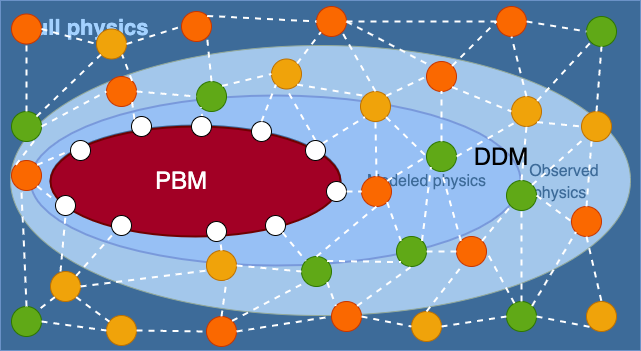
Overview
Hybrid Analysis and Modeling (HAM) represents a paradigm shift in computational modeling by combining physics-based models with data-driven machine learning approaches. This methodology leverages the interpretability and reliability of physics-based models while harnessing the flexibility and adaptability of AI/ML techniques.
I pioneered this approach at SINTEF and NTNU, establishing HAM as a new modeling paradigm that bridges the gap between traditional simulation and modern machine learning.
Research Topics
Corrective Source Term Approach
Using machine learning corrections to improve physics-based simulation fidelity.
Reduced Order Modeling
Developing low-dimensional efficient models to accelerate simulation and control.
Physics Informed Neural Network
Embedding physical laws into neural networks for constrained and data-efficient learning.
Physics Guided Machine Learning
Guiding machine learning with domain knowledge and principled priors for robustness.
Deep Operator Learning
Learning operators that map functions to functions for rapid PDE solution and inference.
Safe Reinforcement Learning
Designing reinforcement learning methods with formal or empirical safety guarantees for control.
Key Projects
RAPID
Hybrid analysis and modeling (10M NOK, 2020-2023)
PoroTwin
Digital twin of porous media flow using hybrid methods
Upgrid
Dynamic loading of cables under varying loads.
dThor
Structural health monitoring using HAM.
Hole Cleaning Monitoring
Monitoring and predictive analytics for hole-cleaning operations using hybrid models.
Bigpressure
High-pressure system monitoring and anomaly detection using physics-guided ML.