Award Winning MSc theses
MSc theses
* Indicates thesis done in collaboraiton with industry.
- * Erlend Nesse, A data-driven framework for evaluating ship performance using air lubrication systems, 2026
- Ulrikke Bjune Hopen, Refining qualitative rules into quantitative rules and learning rule-compliant policies, 2026
- Hanna Gausnes, Predictions using multichannel Electromyography (EMG) signal, 2026
- Hlynur Grimm Berg, Federated Learning and Unlearning with guarentees, 2026
- * Ingeborg Marie Berg Borhaug, An Analysis of Sound Event Detection for Low-Altitude Aircraft in Weather-Noisy Conditions, 2026
- * Vibeke Kvistad Dengerud, Digital twinning of fluid flower porous media flow rig, 2026
- Henrik Kvello Gursli, Heat Assisted Detection and Ranging, 2026
- * Linus Ludescher, Dynamic Loading of Cables, 2026
- Mathias Størseth Otnes, 2026
- * Kari Torfinnsdatter Rønningen, nalysis of Domain Shift and Generalization in Sonar-Based Object Detection for Ghost Fishing Applications, 2026
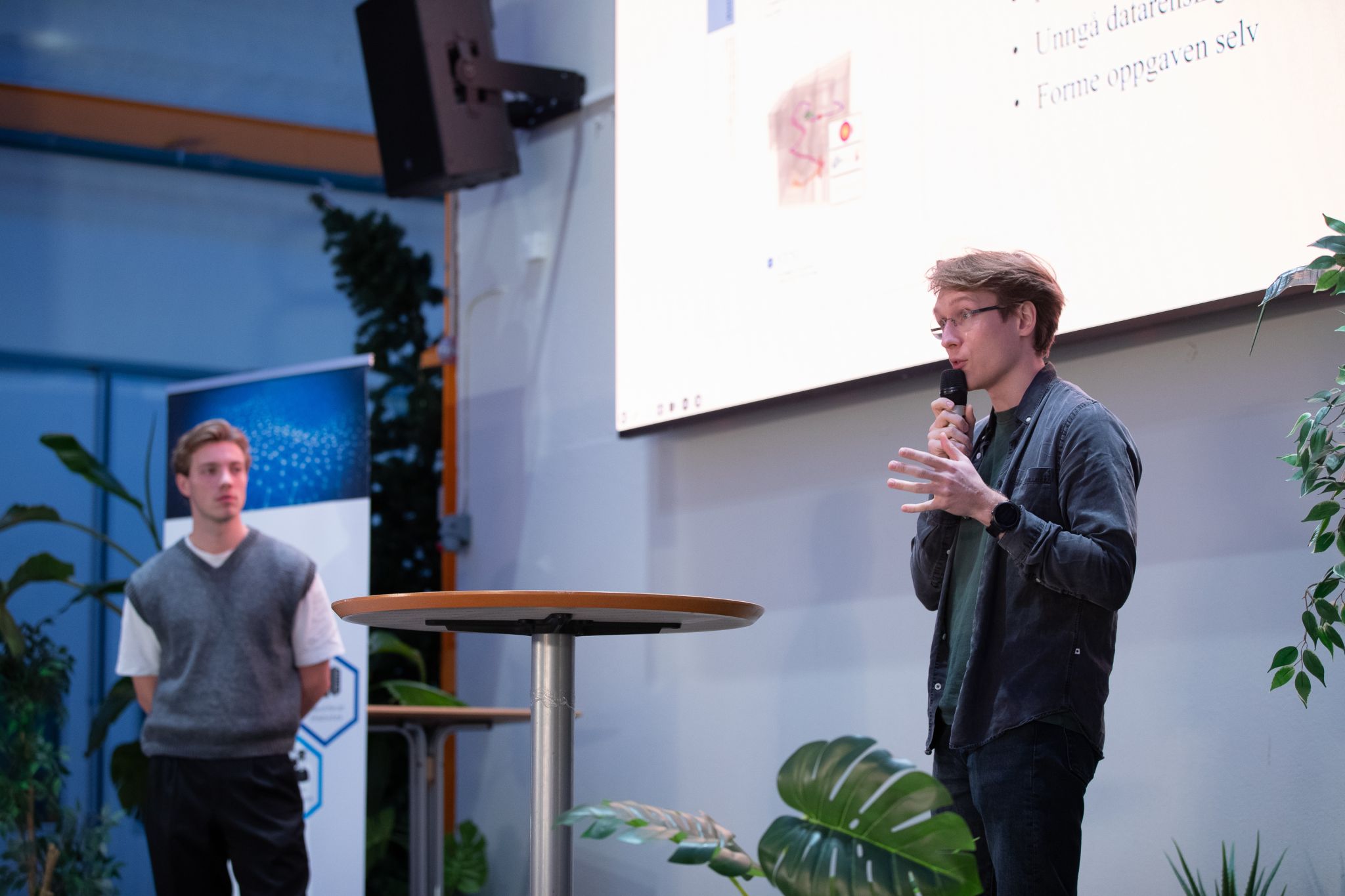
- Mikael Aleksander Jansen Shahly, Adaptive sampling using probabilisitc priors and reinforcement learning, 2026
- Aleksander Østensen, Automated knowledge generation using Agentic Artificial Intelligence, A journal article under review, 2026
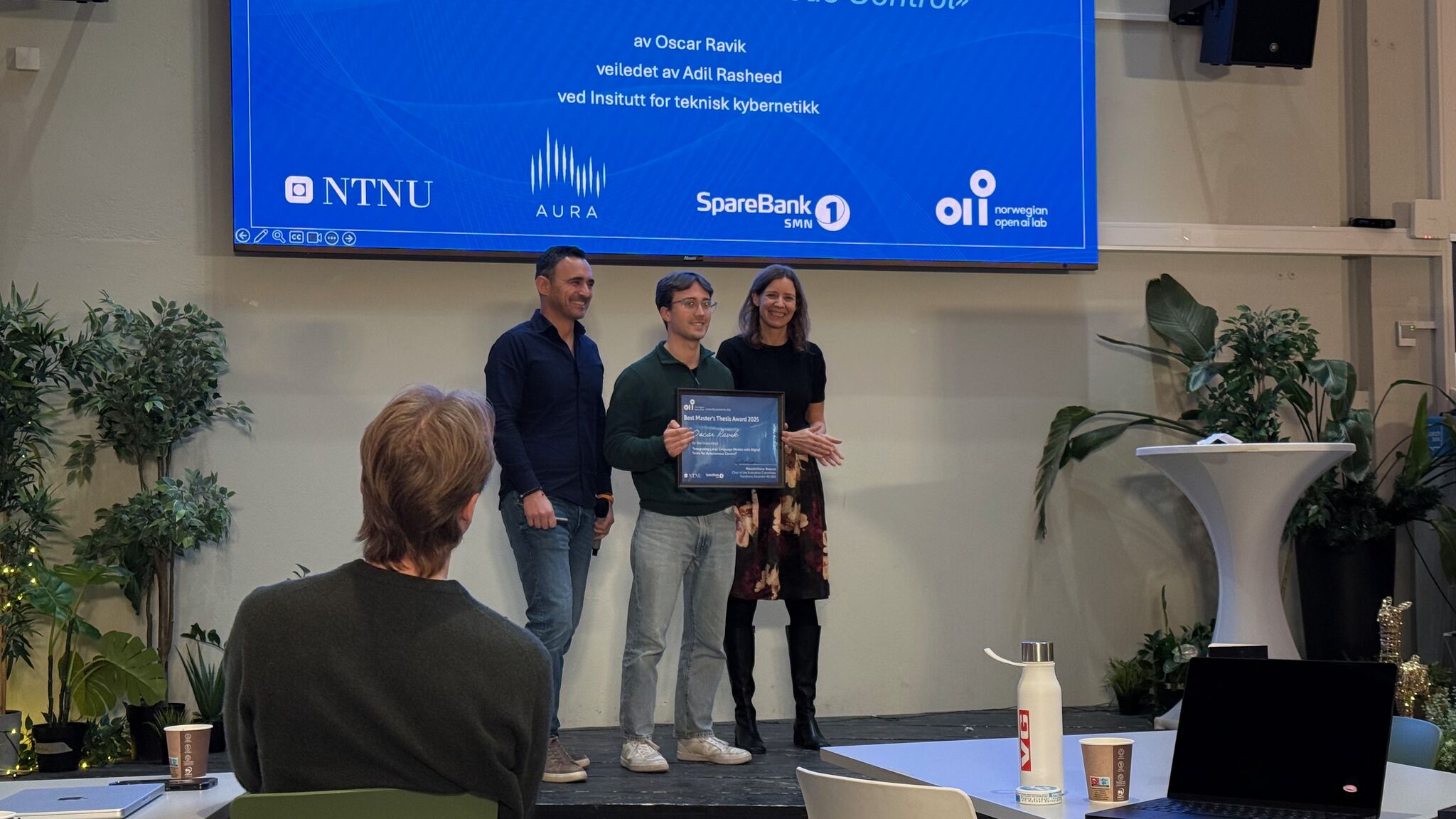
- Oscar Raavik, Integrating Large Language Models with Digital Twins for Autonomous Control, Best MSc. Thesis from OpenAI lab, 2 Journal articles under review, 2025
- David Standal, 2025
- Emil Johnsen, AI based estimation of motor intent, 2025
- * Olav Lill Østerholt, 2025
- Oussama Elbettal, 2025
- Tsvetlin Angelov Petrov, 2025
- * Olea Linnea Andersson, Preventing recidivism after imprisonment: Systemic patterns behind reoffending, 2025
- Andreas Von Brandis, Multi-Target Tracking for Autonomous Surface Vessels - Fusing LiDAR and AIS Data in a Digital Twin Framework, Journal article in Applied Ocean Research, 2024
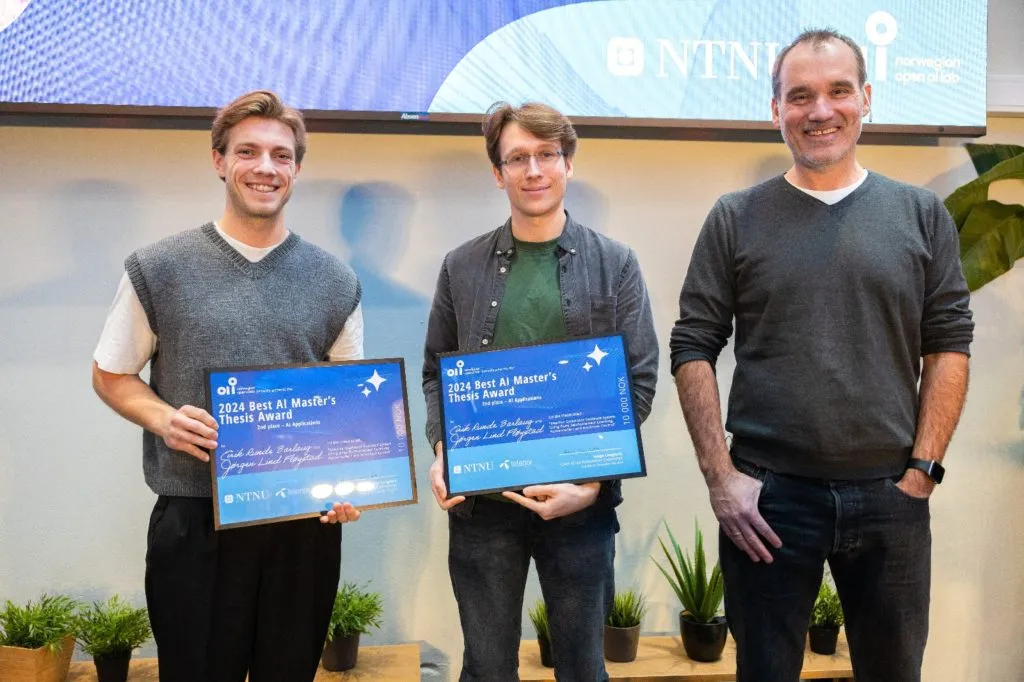
- Eirik Runde Barlaug, Reactive Quadrotor Guidance System Using Deep Reinforcement Learning, Autoencoders and Nonlinear Control, Journal article under review and OMAE paper, NFEA Award, OpenAI Award, 2024
- Henrik Stokland Berg, Deep Reinforcement Learning and Nonlinear Model Predictive Control in Marine Navigation, Journal article in Scientific Reports, 2024
- Jørgen Lind Fløystad, Reactive Quadrotor Guidance System Using Deep Reinforcement Learning, Autoencoders and Nonlinear Control, Journal article under review and OMAE paper, NFEA Award, OpenAI Award, 2024
- Tobias Rotnes Aasen, Optimizing Nonlinear Dynamic Models with Deep Active Learning and Minimal System Interference, 2024
- Elias Buø, Reachability Analysis of Deep Active Learning for Nonlinear System Identification, 2024
- Magnus Selle, The Digital Twin-Ready Aquarium: A Step Towards Industry 4.0 in Aquaculture, 2024
- * Magnus Haaker, 2024
- * Shayan Tafrishi, The Future of Correctional Workforce Management: AI and Societal Cybernetics to the Rescue, 2024
- * Pernille Sofie Pedersen, Statistical and Mathematical Modeling of Supermarket Cabinet Temperature for Demand Response Applications, 2024
- * Kristoffer Arlind, 2024
- Håvard Einarssønn Høymork, Drone-Assisted Temperature Monitoring for Sustainable Control of Residential Climates, 2024
- Marte Eggen, Explainable AI Approaches for Large Generative Transformer-Based Language Models, 2024
- * Hedda Nielsen Dale, 2024
- Albert Johannessen, Physics informed neural network, 2022
- * Jacob Wulff Wold, GAN Based Super-Resolution of Near-Surface 3D Atmospheric Wind Flow with Physics Informed Loss Function, 2023, Journal article in Engineering Applications of Artificial Intelligence
- Henrik Albin Larsson Hestnes, Machine Learning-Enabled Predictive Modeling of Building Performance for Electricity Optimization, 2023
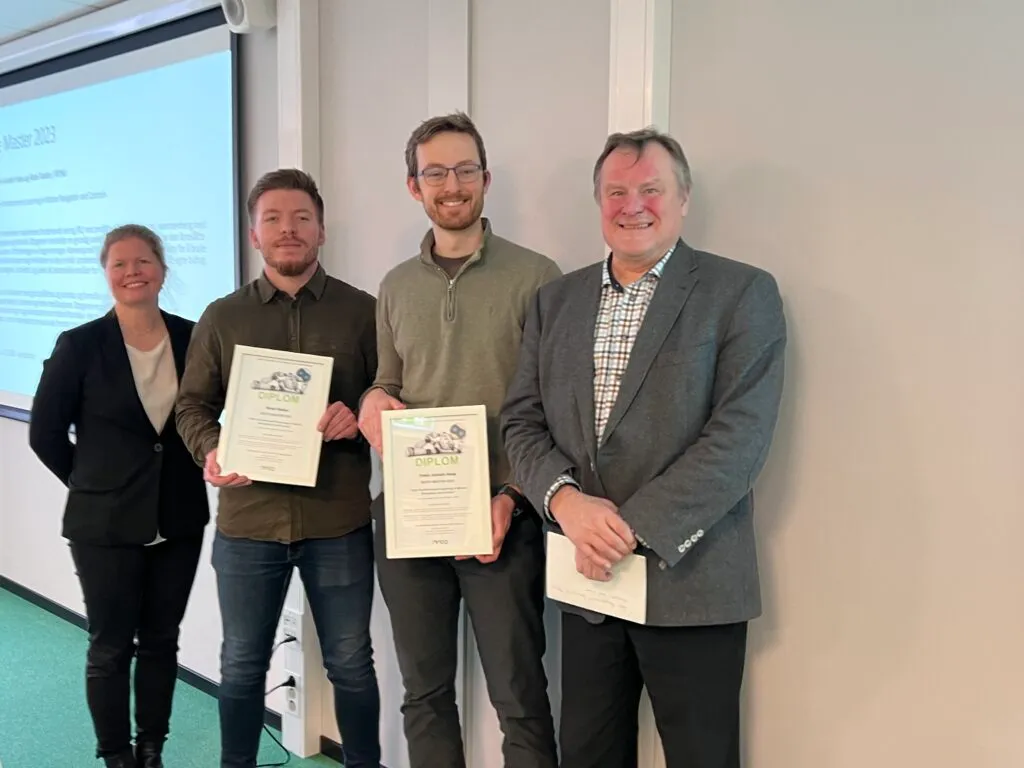
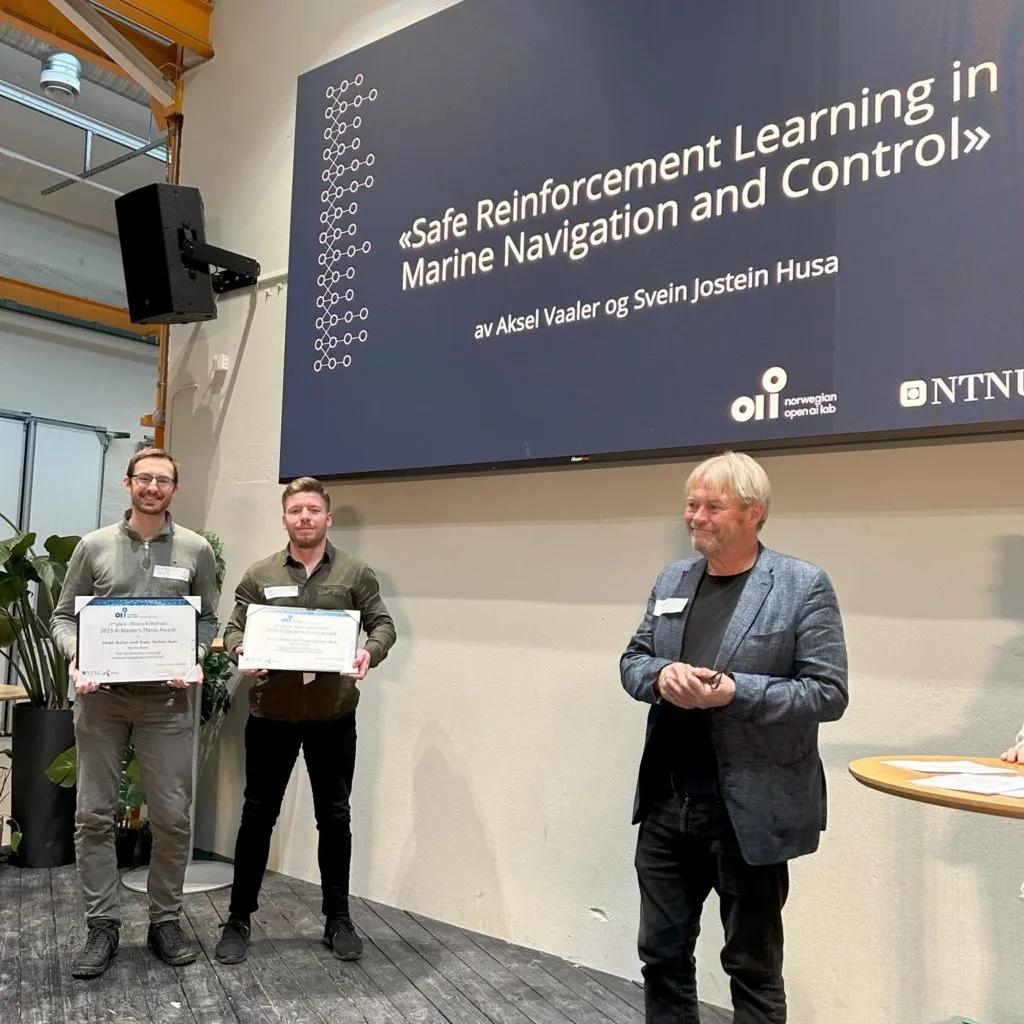
- Aksel Vaaler, Safe Reinforcement Learning in Marine Navigation and Control: Using a Predictive Safety Filter for Safety Verification on Autonomous Surface Vessels, 2023, Journal article in Artificial Intelligence and OMAE paper, NFEA Award, OpenAI Award
- Kristoffer Skare, Unleashing the Potential of AI-Driven Digital Twins A Framework for Research using a Sensor-Enhanced Greenhouse, 2023, Conference paper
- Endre Bruaset, Unleashing the Potential of AI-Driven Digital Twins A Framework for Research using a Sensor-Enhanced Greenhouse, 2023, Conference paper
- * Kristian William Macdonald Gulaker, Object detection in EM2040 point clouds
- * Eivind Dogger, Multi-agent reinforcement learning with graph neural networks for optimizing an industrial sorting system
- Emil Johannesen Haugstvedt, On the Potential of Utilizing Laboratory-Scale Experimental Setup as Proxy For Real-Life Applications: Time Series Analysis and Prediction for Hole Cleaning, 2023, Journal article published in IEEE Access
- Eirik Rugaard Furevik, Physics-guided neural networks for aerodynamic characterization of wind turbines
- Henrik Andreas Gusdal Wassertheurer, Developing a predictive digital twin of a wind farm, 2023
- Ørjan Carlsen, Merging Classical Control and Deep Reinforcement Learning for Dynamic Collision Avoidance for a Quadcopter, 2023
- Svein Jostein Husa, Safe Reinforcement Learning in Marine Navigation and Control: Using a Predictive Safety Filter for Safety Verification on Autonomous Surface Vessels, 2023, Journal article in Artificial Intelligence
- * Jannani JohanRaj, Improving Credit Management Practices: A Transdisciplinary Approach to Optimizing Risk and Profitability, 2023
- * Marthe Aaberg, Improving Credit Management Practices: A Transdisciplinary Approach to Optimizing Risk and Profitability, 2023
- Kristian Brudeli, Path-following and Collision Avoidance using World Models, 2023
- Sondre Sorbø, Corrective Source Term Approach for improving Erroneous Physics-Based Models, 2022, Journal article in Applied Soft Computing
- Simon Mork Sætre, Laying The Foundation For an Artificial Intelligence-Powered Extendable Digital Twin Framework For Autonomous Sea Vessels, 2022, OMAE Conference paper
- * Marcus Skagemo, Stacking classifiers for improved order execution
- Ludvig Løken Sundøen, Path Following for Quadcopters using Deep Reinforcement Learning
- * Lars Gjardar Musæus, Fractal Analysis and Its Application on Time-Series Data – An Innovative Method for Condition Monitoring of Hole Cleaning Operations, 2022
- Elias Mohammed Elfarri, Digital Twin of a Building Powered by Artificial Intelligence and Demonstrated in Virtual Reality, Tekna Award for project idea
- Annfrid Hopland Myklebust, Building a digital twin of the thermodynamic behaviour of a building using hybrid modeling, 2022
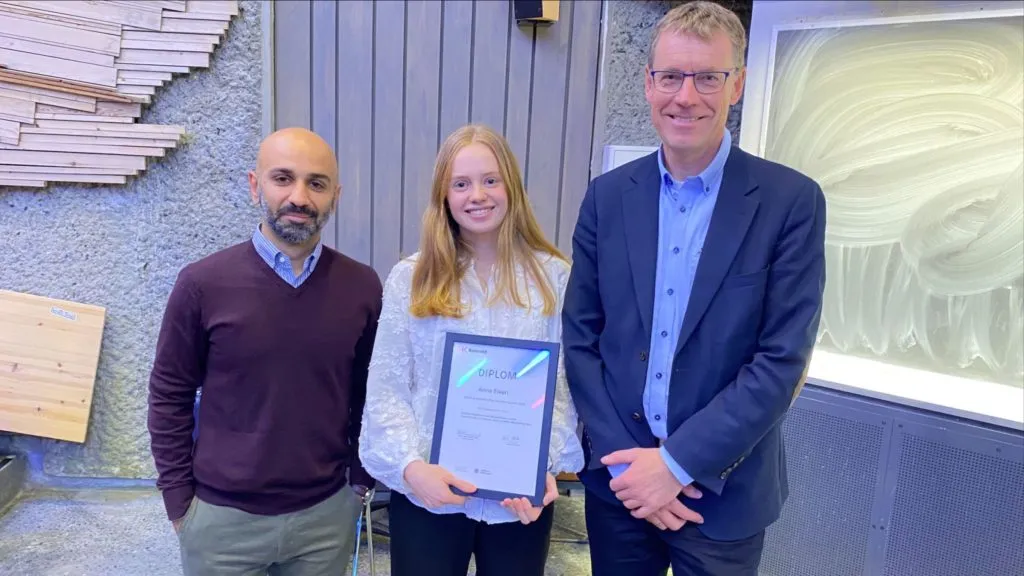
- * Anne Willkommen Eiken, Position Alignment and Geographical Location Determination of Railway Track Condition Monitoring Data, Best Master's thesis award from BaneNor
- * Katarina Charlotte Guderud, Predicting feeding patterns in aquaculture
- Viljer Ness, Simulating Ordinary Differential Equations using the Physics-Guided Machine Learning Framework, 2021
- Vebjørn Malmin, Reinforcement Learning and Predictive Safety Filtering for Floating Offshore Wind Turbine Control, 2021
- * Andrine Elsetrønning, Generalized workflow with uncertainty quantification for detecting abnormalities in lung sounds, 2021
- Julia Marie Graham, Geometric change detection in the context of Digital Twin, leveraging Dynamic Mode Decomposition, Journal article in Digital
- Marie Skatvedt, Sea bottom detection using Doppler Velocity Logger, 2021
- Torkel Laache, Physics Guided Machine Learning: Injecting neural networks with simplified theories, 2021, Journal article in Frontiers in Robotics and AI
- Halvor Ødegard Teigen, Reinforcement Learning and Predictive Safety Filtering for Floating Offshore Wind Turbine Control, 2021, Journal article in Frontiers in Robotics and AI
- Ole-Jørgen Hannestad, Securing trust in AI systems through increased explainability, 2021
- Bendik Austnes, Increasing Validity and Uncovering Utility in Machine Learning Studies, 2021
- * Olav Landmark Pedersen, A proof-of-concept Digital Twin implementation for monitoring patients through the Clinical Pathway for Prostate Cancer, 2021
- Fredrik Pettersen, Making a digital twin of a heterogeneous rod under transient heat transfer
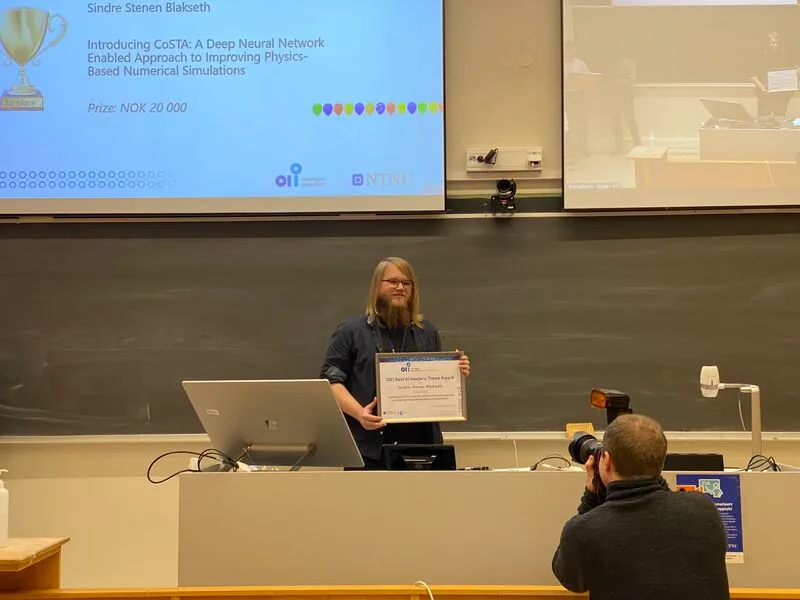
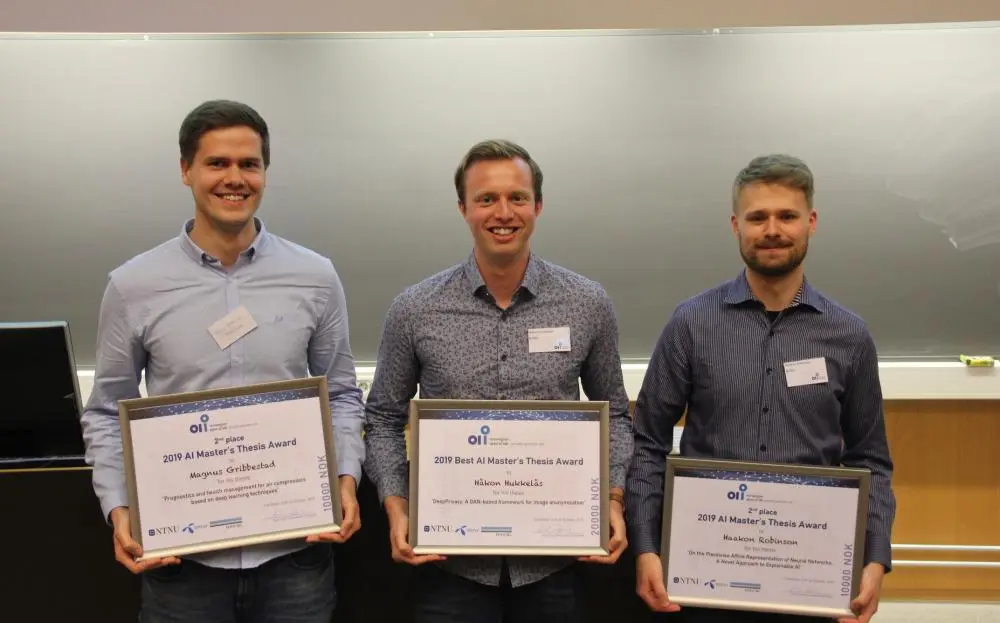
- Sindre Stenen Blakseth, Introducing CoSTA: A Deep Neural Network Enabled Approach to Improving Physics-Based Numerical Simulations, 2021, Best Masters thesis award from the Norwegian Open AI Lab, 2 Journal articles in Neural Networks and Applied Soft Computing
- Tiril Sundby, Towards Geometric Change Detection in Digital Twins using Dynamic Mode Decomposition, Object Detection and 3D Machine Learning, 2020, Journal article in Digital
- Daniel Nakken, A strategy controller for concave obstacle avoidance, 2020
- Thomas Nakken, On the applicability of a perceptually driven generative-adversarial framework for super-resolution of wind fields in complex terrain, 2020
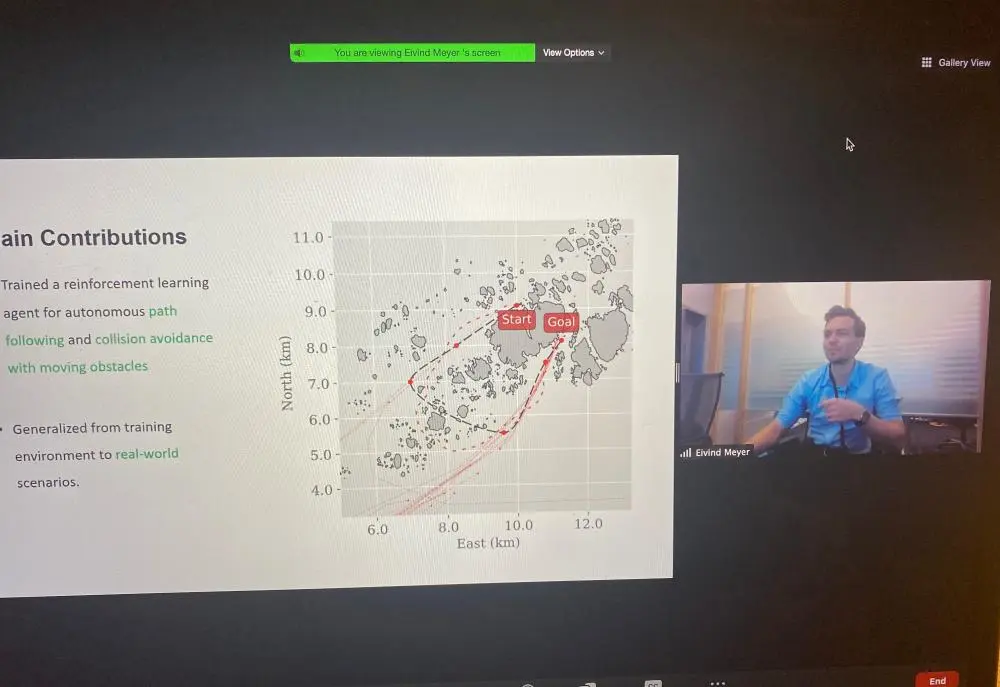
- Eivind Meyer, On Course Towards Model-Free Guidance: A Self-Learning Approach To Dynamic Collision Avoidance for Autonomous Surface Vehicles, 2020, Best Masters thesis award from the Norwegian Open AI Lab, 2 Journal Articles in IEEE Access
- * Eirik E. Vesterkjær, Combining grid-based uncertainty propagation and neural networks with uncertainty estimation, 2020
- * Herman Stavelin, Biomass estimation using sonar and machine learning, 2020, Journal Article in Ecological Informatics
- Duy Tan Tran, Convolutional Neural Network and Generative Adversarial Networks Enabled Resolution Enhancement of Numerical Simulations, 2020, Best poster award at the Deep Wind Conference
- Simen Theie Havenstrom, From Beginner to Expert: Deep Reinforcement Learning Controller for 3D Path Following and Collision Avoidance by Autonomous Underwater Vehicles, 2019-2020, Journal Article in Frontiers in Robotics and AI
- Amalie Heiberg, Risk-based reinforcement learning for path following and collision avoidance, 2019-2020, Journal Article in Neural Networks
- Haakon Robinson, On the Piecewise Affine Representation of Neural Networks, 2019, Runner-up best Masters thesis award from the Norwegian Open AI Lab
Specialization Projects
- Håvard Hellerslia Akselsen, Exploring LLM-in-the-loop Rule Refinement for COLREG Compliance, 2025
- Hlynur Grimm Berg, Building a Modular Framework for Federated Learning and Unlearning Research, 2025
- Ingeborg Marie Berg Borhaug, An Analysis of Sound Event Detection for Low-Altitude Aircraft in Weather-Noisy Conditions, 2025
- Vibeke Kvistad Dengerud, Latent-Space Reduced-Order Modeling of CO2 Plume Evolution Using Convolutional Variational Autoencoders and Dynamic Mode Decomposition for Predictive Digital Twins, 2025
- Henrik Kvello Gursli, Heat-assisted detection and ranging, 2025
- Linus Ludescher, Dynamic cable load temperature optimization laboratory with digital twin integration, 2025
- Mathias Størseth Otnes, Comparative Analysis of Neural Implicit Representations and Dense Voxel Grids for 3D Reconstruction, 2025
- Kari Torfinnsdatter Rønningen, Analysis of Domain Shift and Generalization in Sonar-Based Object Detection for Ghost Fishing Applications, 2025
- Mikael Aleksander Jansen Shahly, ask-Aware Adaptive Sparse Sensing using Variational Autoencoder and Reinforcement Learning, 2025
- Aleksander Østensen, Evaluating Local Large Language Models as Controllers in Closed-Loop Dynamical Systems, 2025
- Oscar Erik Raavik, Preparing Greenhouse for Autonomous Control, 2024
- David Standal, Annotation-Free Supervised Learning for Optical Sea Ice Segmentation, 2024
- Olav Pålerud Lille-Østerholt, Usability and Engagement for Educational VR experience, 2024
- Oussama Elbettal, 2024
- Tsvetelin Angelov Petrov, 2024
- Kristine Stabell, Trajectorial risk assessment of autonomous surface vessels using AIS data, Bayesian networks, and machine learning, 2023
- Andreas Von Brandis, Introducing predictive capabilities for an Autonomous Surface Vessel in a Digital Twin framework, 2023
- Eirik Runde Barlaug, Low-Dimensional Latent Encodings for Enhanced Reinforcement Learning-Based Collision Avoidance, 2023
- Henrik Stokland Berg, CNN-based situational awareness in marine applications; neural network search, 2023
- Jørgen Lind Fløystad, Bi-Rotor Drone Doing Path Following and Collision Avoidance in the Vertical Plane Using Deep Reinforcement Learning, 2023
- Vegard Bergum Hovland, Autonomous data sampling with a quadrotor drone using a digital twin of a smart house, 2023
- Tobias Rotnes Aasen, General Deep Active Learning Framework for Nonlinear System Identification, 2023
- Elias Buø, Nonlinear System Identification of Maneuvering Model using Deep Active Learning, 2023
- Magnus Selle, Digital Twin-ready Aquarium, 2023
- Magnus Haaker, Unveiling Trends and Challenges in Modern Logistics, 2023
- Olea Linnea Andersson, Samfunnskybernetikk: Measuring the organizational health in companies from different industries using cybernetics analytics, neuroscience, psychology, etc.
- Shayan Tafrishi, Samfunnskybernetikk: Measuring the organizational health in companies from different industries using cybernetics analytics, neuroscience, psychology, etc.
- Pernille Sofie Pedersen, Ambient Temperature-Based Predictive Modeling of Energy Consumption for Standard Operations of a CO2 Cooling System in Porsgrunn, Norway, 2023
- Kristoffer Arlind, The Use of Market Paradigm Adaptive Machine Learning Models for Short Term Stock Return Prediction
- Gjermund Bae, Digital Twins of Listed Companies to Accelerate the Net Zero Transition
- Håvard Einarssønn Høymork, Autonomous Temperature Monitoring in a Dense Environment using a Micro Aerial Vehicle, 2023
- Marte Eggen, Explainable AI on transformer models (HUNT dataset)
- Hedda Nielsen Dale, Identifying Pain Points in the Industrial Value Chain: A Mixed-Methods Analysis
- Albert Johannessen, Physics informed neural network, 2022
- Eivind Dogger, Reinforcement learning for efficient control of parcels in an automated logistics system, 2022
- Aksel Vaaler, Safe learning of small passenger ship, 2022
- Emil Johannesen, Corrective Source Term with Sparse Neural Networks, 2022
- Endre Bruaset, Experimental setup for discovering a dynamical model of plant growth, 2022
- Erik Rugaard Furevik, Developing a wind forecast system for predictive digital twins, 2022
- Hannah Hansen, CNN-based situational awareness and risk estimation using LiDAR perception in marine applications, 2022
- Henrik Albin Larsson Hestnes, Digital Twin for Built Environment, 2022
- Henrik Andreas Gusdal Wassertheurer, Developing a wind forecast system for predictive digital twins, 2022
- Jannani Johanraj, Digital twin for business processes, 2022
- Kristoffer Skare, Numerical setup for discovering a dynamical model of plant growth, 2022
- Marte Aaberge, Digital twin for business processes, 2022
- Ørjan Carlsen, Adversarial Reinforcement Learning ("Trial-by-Fire"), 2022
- Svein Jostein Husa, Approximate MPC control of neural network dynamics, 2022
- Sondre Sorbø, Physics Guided Neural Network-assisted Corrective Source Term Approach to Hybrid Analysis and Modeling, 2021
- Simon Mork Sætre, Machine Learning in Unity, 2021
- Marcus Skagemo, Improved market entry of long-term time horizon trading signals using short-term residual reversal, 2021
- Ludvig Løken Sundøen, Path Following for Quadcopters using Deep Reinforcement Learning, 2021
- Lars Gjardar Musæus, Railway Track Condition Monitoring and Data-Driven Predictive Maintainance, 2021
- Elias Mohammed Elfarri, Digital Twin of Smart Housing: An Initial Setup of a Digital Twin Using The Capability Levels Framework, 2021
- Annfrid Hopland Myklebust, Building a digital twin of the thermodynamic behaviour of a building using hybrid modeling, 2021
- Anne Willkommen Eiken, Analysis of alignment methods for railway track geometry measurements, 2021
- Katarina Charlotte Guderud, Predicting feeding patterns in aquaculture
- Daniel Vennestrøm, Industry 4.0 digital twin for mobile robots operating in energy industry facilities, 2021
- Hanna Backer Malm, Digital Twin for Enterprises, 2020
- Viljer Ness, Digital Twin for Enterprises, 2020
- Vebjørn Malmin, Model Predictive Control using Deep Neural Network, 2020
- Andrine Elsetrønning, Machine Learning based anomaly detection in lung sound data, 2020
- Julia Marie Graham, Combining Dynamic Mode Decomposition and Compressed Sensing for intrusion detection, 2020
- Marie Skatvedt, Sea bottom detection using Doppler Velocity Logger, 2020
- Torkel Laache, Reinforcement learning for path following and collision avoidance under the influence of wind and current, 2020
- Halvor Ødegard Teigen, Reinforcement learning for path following and collision avoidance in 3-D, 2020
- Ole-Jørgen Hannestad, Explainable artificial inelligence for bussinesses, 2020
- Raja Iqran Iftikar, Bead classification in developing COVID-19 kit, 2020
- Bendik Austnes, Analysis of hyperspectral images for detecting skin disease, 2020
- Olav Landmark Pedersen, 2020
- Fredrik Pettersen, Making a digital twin of a heterogenous rod under transient heat transfer, 2020
- Sindre Stenen Blakseth, Hybrid Analysis and Modeling, 2020
- Kari Moe, GANS assisted design of prosthetic arms for third world amputees, 2020
- Eivind Meyer, Path Following and Collision Avoidance for Surface Vessel using Reinforcement Learning, 2019
- Eirik E. Vesterkjær, Uncertainty Propagation and Applications to Neural Networks, 2019
- Herman Stavelin, Object Detection Applied to Marine Data for Species Classification and Biomass Estimation, 2019
- Duy Tan Tran, Generative Adversarial Networks assisted super-resolution simulation of atmospheric flows in complex terrain, 2019
- Simen Theie Havenstrom, 3D Path Following and Motion Control for Autonomous Underwater Vehicles Using Deep Reinforcement Learning, 2019
- Haakon Robinson, Reinforcement Learning based controllers for autonomous ships (path following with collision avoidance), 2018
- Camilla Sterud, Reinforcement Learning based controllers for underwater vehicles (path following with collision avoidance), 2018
- Daniel Nakken, Machine Learning Controllers for Robotic Manipulator, 2018
Courses Taught
TTK4260
Introduction to Multivariate Data Analysis
Current
TTK8117
Advanced Multivariate Data Analysis
Current
TTK29
Hybrid Analysis and Modeling for Digital Twins
Current
TTK4853
Virtual Reality based Digital Twins
2023
TTK4853
Experts in Team: Explainable AI
2021
TTK4853
Hybrid Modeling for Digital Twins
2020
80+
MSc Students Supervised
10+
Thesis Awards Won
6
Courses Taught
50+
Journal Publications from MSc Work